Illustrative visualization
07 / Load-out
Lift and secure.
Protection, lifting plan, restraint points and trailer configuration are verified before release.
Gate / Load securedCanadian-engineered modular data centres
Modular data centre infrastructure
Factory-built power, cooling and compute.
Online in months. Built to scale, upgrade and move.
 Illustrative product cutaway · project-specific engineering
Every module starts with the equipment going inside it. The size, weight, power and cooling needs of your racks shape the whole design. Our standard layout holds the racks, and the hardware you choose sets how much computing power fits.
From the steel frame to the compute tray. Open the assemblies, trace the systems and cut through the enclosure.
 C625ENGINEERING STUDIO
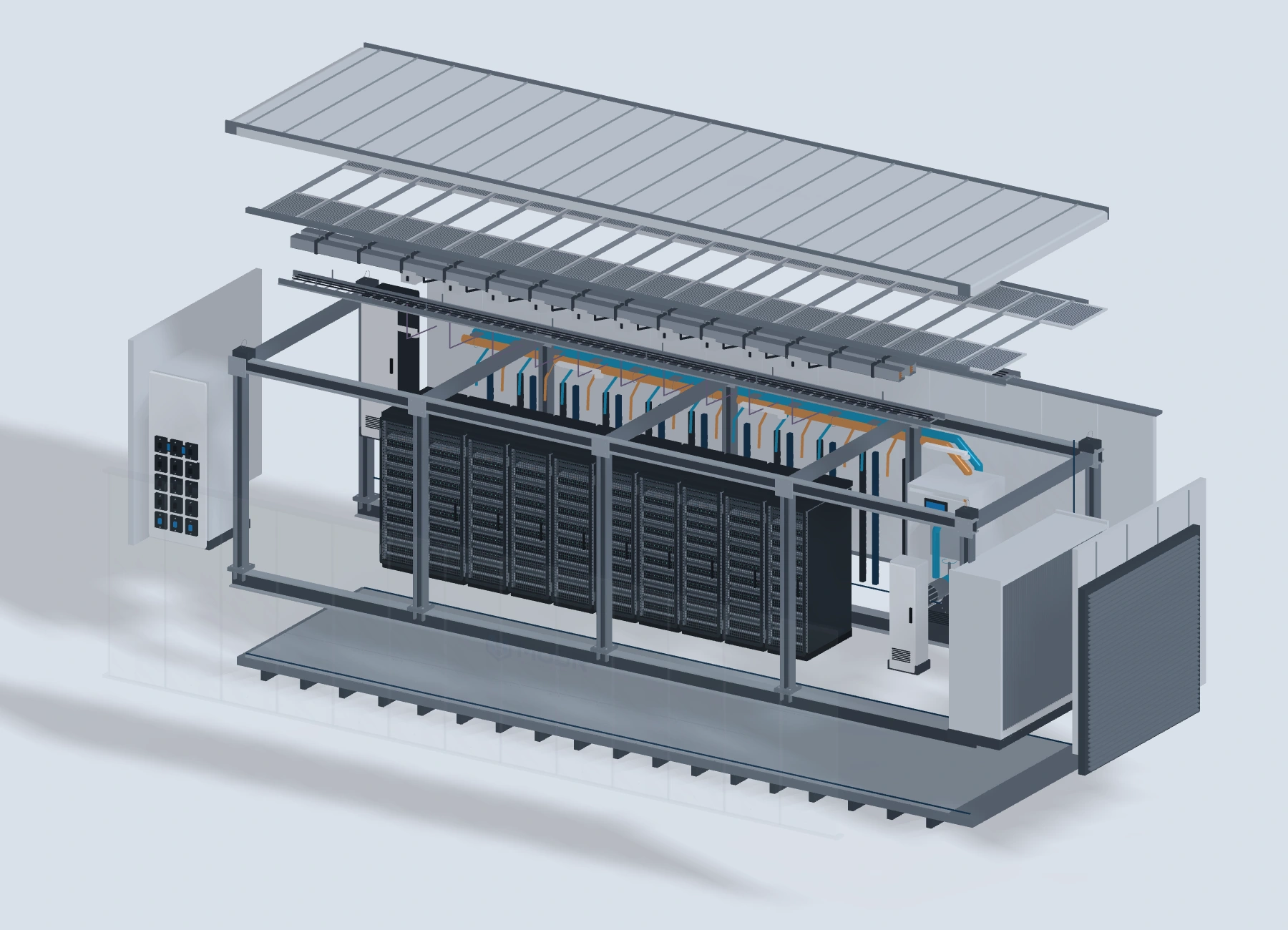
Loading geometry and service assemblies…
Assembly opens the physical layers. System paths explain the connections. Section cut reveals what sits behind the enclosure.
Each C Series block is a factory-built unit. Pick the size that fits your phase, then add the next block when you need it. Every block is sized to your workload, equipment and site.

A first deployment, dedicated workload or regional capacity requirement.
Inspect C625
A first production deployment, or two workloads that share one site.
Inspect C1000
Regional AI inference, enterprise and sovereign capacity.
Inspect C1500
AI and HPC clusters, and colocation phases.
Inspect C2000
AI and HPC, colocation and phased campus development.
Inspect C3000When services clash, installed work must change. Crews redo connections, equipment waits, and the programme moves while the site catches up.
A large service blocks the cable route. The packages cannot connect as planned.
Installed sections come back down while the next trade waits for access.
Equipment has arrived. Unfinished site connections prevent installation.
Conventional site / illustrative scenario
The module follows one governed path. Site foundations, utilities and network preparation run in parallel and converge at installation.
Approved drawings, specifications, equipment schedules and structural, electrical, thermal and controls interfaces are released for manufacture.
Design releasedThe module is fabricated, equipped, wired, piped, integrated and verified in a controlled production environment.
Factory test acceptedThe completed module is protected, lifted, positioned and restrained on its project-specific trailer.
Load securedRoute, permits, escorts, site access and delivery timing are coordinated as one controlled movement.
Delivered to siteProject requirements change. The interfaces and deployment logic stay disciplined.
Rack, containment and facility interfaces configured for modern densities and liquid-ready architectures.
Factory-integrated power blocks from medium-voltage intake through UPS, batteries and low-voltage distribution.
Coordinated heat-transfer, pumping, CDU and rejection systems for high-density compute loads.
Carrier, meet-me, network and security infrastructure connected through a common campus architecture.
Common instrumentation and supervisory interfaces across equipment, modules and the complete campus.
Security, workshop, spares and operational spaces designed inside the same modular discipline.
Concept visualizations. Hover or tap a module for details.
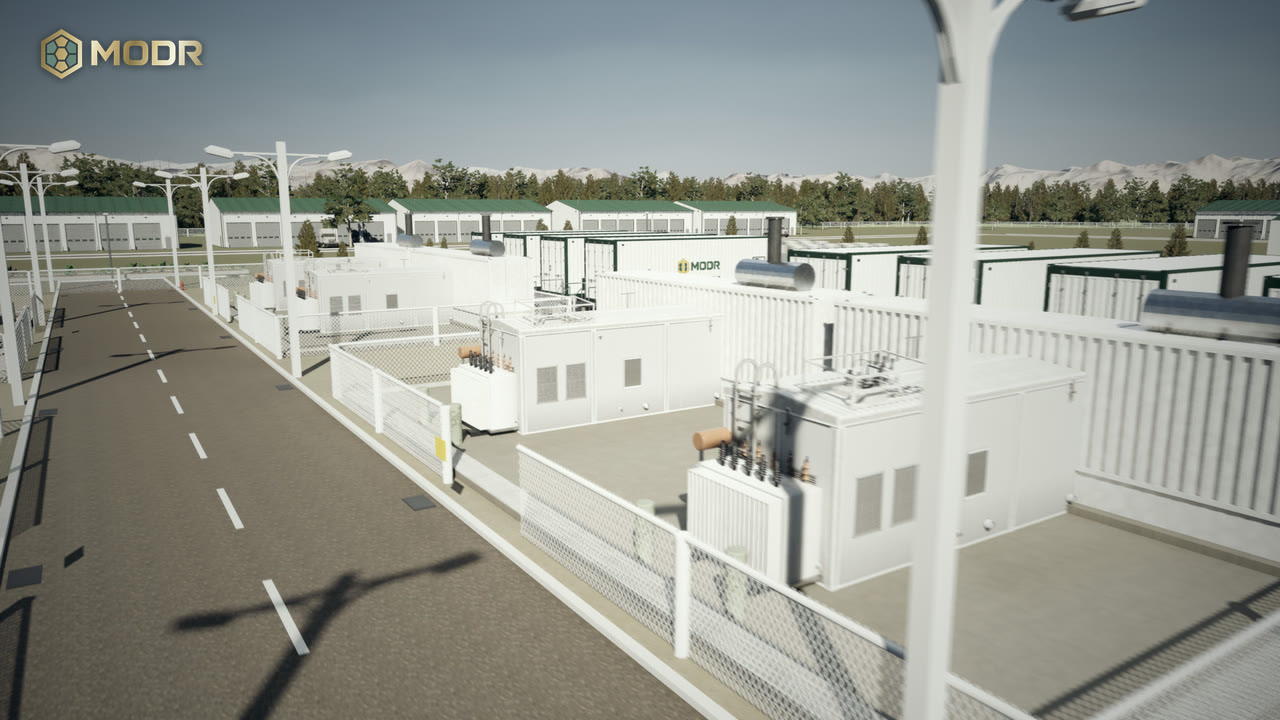
The interactive view loads as you approach.
Load engineering, route planning, delivery control and site lifting are treated as one coordinated package—not handed off as disconnected logistics.
Protection, lifting plan, restraint points and trailer configuration are verified before release.
Gate / Load securedRoute, permits, escorts, site access and delivery window are coordinated around one arrival plan.
Gate / Delivered to siteThe module is placed, joined to the prepared spine, site-tested and commissioned as one system.
Gate / Commissioned capacityBuild and test in the factory while the site takes shape. The objective: a shorter onsite programme, less material waste and lower installed cost.
Based on MODR’s 9-month target against a 24-month conventional baseline.
Factory integration and site preparation progress in parallel, then converge at installation.
Repeatable designs, controlled material use and fewer onsite rework cycles.
Illustrative waste index · conventional baseline = 100
Designed for lower installed cost, through three repeatable delivery levers.
Standard interfaces reduce redesign between deployments.
Reduce field labour, repeated mobilization and avoidable rework.
Defined equipment schedules give procurement a consistent basis.
The schedule and waste figures are MODR management targets, subject to validation through reference deployments. The schedule comparison covers time on site, not total project lead time. Permitting, utility availability, equipment lead times and site conditions affect the programme. Cost savings are project-specific.
Projected global data-centre electricity consumption in 2030.
Projected growth in AI-focused data-centre electricity use from 2025 to 2030.
Projected data-centre share of worldwide electricity demand in 2030.
Projected global capacity growth between 2025 and 2030.
Potential installed data-centre capacity by 2030.
Infrastructure, real-estate value and tenant IT fit-out estimated by JLL.
Liquid-ready infrastructure for accelerated compute and changing rack densities.
Repeatable capacity blocks and consistent operating practices across a portfolio.
Compute, power and thermal modules coordinated into campus-scale systems.
Packaged infrastructure for controlled, regional or constrained environments.
Set critical capacity, rack density, resilience, cooling architecture, site conditions and schedule. MODR turns the agreed basis into a coordinated delivery system.
Define a project